
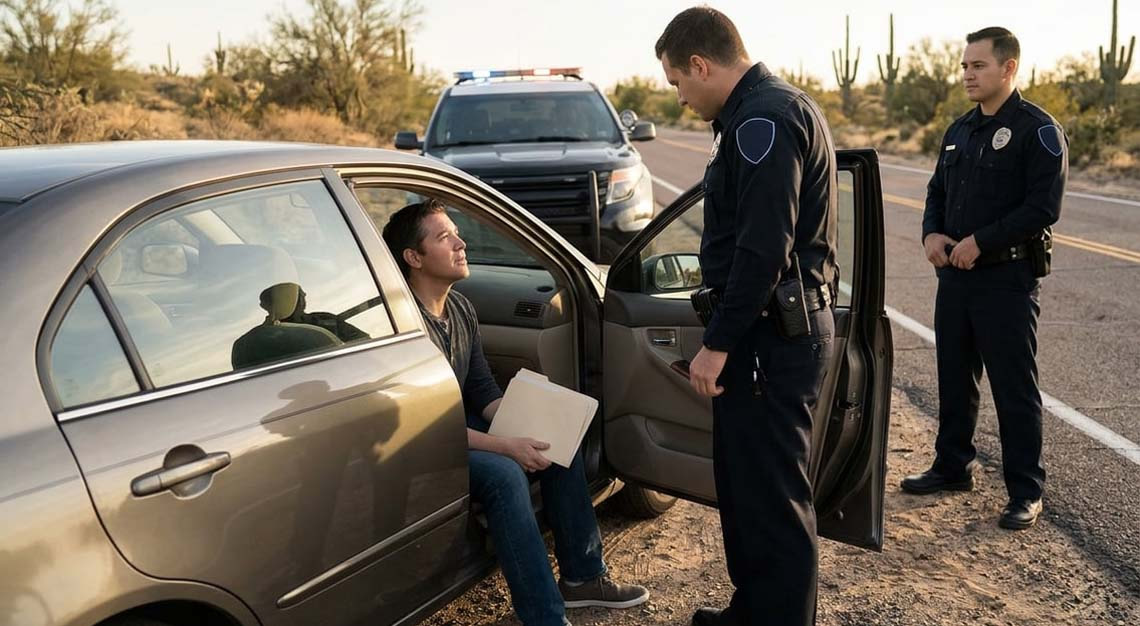
What Should I Do Immediately After a DUI Arrest in Arizona: Key Steps to Protect Your License and Your Case
Arizona has some of the strictest drunk driving laws in the country, and a DUI arrest in Arizona starts two clocks at once: a criminal case in court and a separate action against your license. What you do in the first hours and days shapes both.
Right after a DUI arrest in Arizona, stay calm, give only your name and basic ID, ask for a lawyer, keep every piece of paper you receive, request your MVD hearing before the deadline, and call an Arizona DUI attorney within 24 to 48 hours. If you take those steps, you protect your license, keep your evidence intact, and avoid adding new charges.
Key Takeaways

Most of the damage in a DUI case comes from what happens in the first two days, so your early moves count most.
- Arizona DUI laws are harsh. Even a first offense carries mandatory jail time.
- Silence protects you. Give identifying details, then politely ask to speak with a lawyer before you answer questions.
- The MVD deadline is short. You have 30 days from the date on your suspension notice to request a hearing. Some older guides list 15 days, so check the date on your notice right away.
- Paperwork and notes are evidence. Save every document and write down what happened at the stop, the roadside tests, and the breath or blood test.
- Local rules vary. Court steps and the number of appearances differ by city and county.
- Help is available early. Mesa DUI Lawyer's Arizona DUI team can review your case starting on day one.
Keep Your Composure and Protect Your Right to Silence

Staying calm and saying very little is the best way to protect your case after an arrest. Your words and your behavior both end up in the police report.
Be polite with officers. Arguing or pulling away can lead to a resisting arrest charge, and Arizona courts take that seriously. Prosecutors and judges read the report later, and a respectful tone helps you.
You must give your name, date of birth, and address. Beyond that, you have the right to stay quiet. Do not offer details about:
- How many drinks you had
- Medications you take
- Any past DUI
- Written statements or apologies
Use a simple line: "I want to remain silent, and I want to speak with a lawyer before I answer questions." A court cannot punish you for saying this. It also gives your lawyer a cleaner record to work with later.
The Booking and Release Process in Arizona
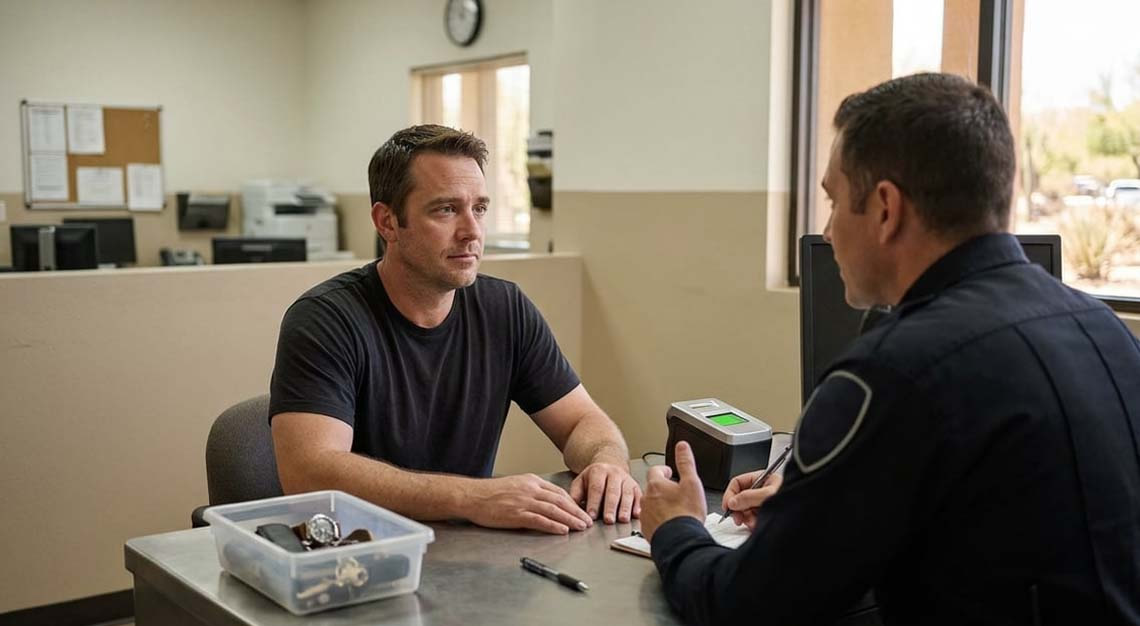
After the arrest, officers take you to a police station or county jail for DUI booking and release. Booking is routine and follows the same pattern across the Arizona DUI process.
Expect these steps:
- Fingerprints taken with LiveScan
- A mugshot for state records
- A list of your personal items, such as cash, jewelry, and belts
- A short medical check
- DUI paperwork
Officers may give a breath test or arrange a blood draw during this time. In some cases they ask for a urine test. These results can support a conviction later.
Go along with the basic booking steps. Keep declining questions about your driving, your drinking, or how you did on roadside tests until you talk with a lawyer.
Most people arrested for a first DUI leave the same day or the next morning. You might be released on your own promise to return, or after paying bail. For first-time cases, bail runs about $1,000 to $5,000, based on the county and the facts. Release rules may include no drinking, no driving without a valid license, or a future ignition interlock if a judge orders one.
Tip: Put all booking and release papers in one folder. They list your charges, your first court date, and any license action.
Roadside Tests, Chemical Tests, and Arizona's Implied Consent Rule

The officer's notes, your field sobriety tests, and your chemical testing results make up the core of the state's case. Each piece can be checked for mistakes.
Field sobriety tests are standard exercises officers use to judge impairment. Federal research gives them these accuracy rates:
|
Test |
NHTSA Accuracy Rate |
|---|---|
|
Horizontal Gaze Nystagmus (HGN) |
77% |
|
Walk-and-Turn |
68% |
|
One-Leg Stand |
65% |
These sobriety tests involve a lot of judgment. Sloped ground, dim light, health problems, shoes, and age all lower their accuracy. Even if you think you passed, do not count on the charge going away without a lawyer.
Arizona's implied consent law, A.R.S. 28-1321, says a driver who is lawfully arrested for DUI must take a breath test or blood test. The officer reads you an implied consent notice explaining this. Refusing leads to a 12-month suspension for a first refusal, and 24 months for a second refusal within 84 months.
Prosecutors rely on breath test printouts and blood lab reports that show your blood alcohol concentration (BAC). Keep any paper showing your BAC or an alleged refusal. Your lawyer can check whether the test was done right, whether the officer had good grounds to arrest you, and whether your rights were respected under ARS 28-1321.
Check Your Papers and Lock In Your Court Date

Sort through your DUI paperwork within hours of release, because it holds your court date and your license deadline. Missing either one creates new problems.
Your Arizona DUI paperwork may include:
- A citation or complaint naming the charge, such as standard DUI under A.R.S. 28-1381, extreme DUI under A.R.S. 28-1382, or aggravated DUI under A.R.S. 28-1383
- Release conditions
- A temporary driving permit or a form showing your license was taken
- Your first court date and courthouse address
- An MVD notice and, if you refused testing, an implied consent affidavit
Skipping your first court date leads to a bench warrant, possible new charges, license trouble, and higher bond. That first hearing is the arraignment. The judge tells you the charges and asks for your plea.
Write the date, time, and courthouse in your calendar. Your case might be at Phoenix Municipal Court, Maricopa County Superior Court, or a local justice court. Set more than one phone reminder. Talk with a lawyer before arraignment, since pleading guilty early takes away your chance to review the evidence and bargain.
The MVD notice has its own deadline, separate from the DUI court process. If your papers are confusing, have a lawyer read them. A charge listed as extreme DUI carries heavier penalties than a standard charge, and it shapes how you plan your defense.
Write Down Every Detail of Your Stop While It's Fresh

Write down everything you remember within 24 hours, because memory fades fast. Studies suggest people forget about half of new details within an hour and about 70% within a day.
About the stop:
- Date and exact time
- Street, city, and county
- Weather and road conditions
- The reason the officer gave for stopping you
- The officer's name and agency
About the roadside tests:
- When and where they happened
- The instructions you got, and anything that confused you
- Injuries or health issues that affected you
- Uneven ground or poor lighting
About chemical tests:
- The order of breath tests or blood draws
- Whether officers watched you for the required 15 to 20 minutes first
- Whether you burped, threw up, or used gum or mouthwash
- Anything the officer said about results
Timing details feed directly into DUI evidence review. Arizona's two-hour rule for alcohol results looks at your BAC within two hours of driving, so exact times can expose weak spots.
Get names and phone numbers for passengers, bar staff, or friends who saw you that night. Save digital DUI evidence too:
- Rideshare receipts
- Credit card charges
- Phone location history, such as Google Timeline
- Text messages that show your timeline
Your car may be impounded for 30 days. Fees run around $150 plus towing, and you need proof of ownership and insurance to get it back.
Guarding Your License After the Arrest

Your license faces its own case through the Arizona Motor Vehicle Division, apart from the criminal charges. You have to act on both tracks.
If you failed a breath or blood test, or the officer says you refused, the officer sends a sworn report to MVD. That starts an administrative license suspension, often called admin per se. You stop it only by requesting an MVD administrative hearing. You must request the hearing within 30 days of the date on your MVD suspension notice, or the suspension starts automatically. Your temporary driving permit lets you drive until then.
|
Situation |
Suspension Length |
|---|---|
|
Failed breath or blood test (BAC 0.08% or higher), first offense |
90 days |
|
First test refusal |
12 months |
|
Second refusal within 84 months |
24 months |
Check your status with MVD or a lawyer before you decide you can or cannot drive. A restricted license may be possible after part of a suspension. Ignition interlock requirements come into play after a conviction, and you pay for the ignition interlock device yourself. More on license suspension after a DUI can help you plan.
Insurance costs often jump 50% to 300%, and you may need an SR-22 filing as a high-risk driver.
Warning: Driving on a suspended license can turn your case into an aggravated DUI, a felony with mandatory prison time.
Bring In an Arizona DUI Attorney Early

Calling an Arizona DUI attorney within 24 to 48 hours is one of the strongest moves you can make. Early help keeps evidence from disappearing and deadlines from slipping by.
A lawyer reviews your citation, the police report once it's ready, and your test results to spot problems. Common DUI defenses in Arizona include an illegal stop, roadside tests given on bad ground, breath machines that were not maintained, and blood samples handled poorly.
Bring this to your first meeting:
- Date, time, and place of arrest
- The arresting agency
- Which tests you took
- Any prior DUI
- Job or professional license worries
Police dashcam and bodycam video, plus security footage from nearby stores, can be erased within 30 to 90 days. An Arizona DUI lawyer can request it before it's gone and file your MVD hearing request on time.
Local lawyers know the judges, prosecutors, and court habits in your area. Tips on finding the best DUI lawyer in Arizona can help you compare options. Mesa DUI Lawyer's team handles DUI defense by negotiating with prosecutors, challenging evidence, explaining plea choices, and preparing for trial when needed.
Handle Daily Life in the First Two Days
Getting organized in the first 48 hours lowers stress and keeps you from making new mistakes.
Getting around: Use rideshares, buses, Valley Metro light rail, or a trusted friend. Do not drive if your license status is unclear. Driving while suspended creates a far bigger problem.
Staying organized: Make one folder, paper or digital, for court notices, MVD letters, and lawyer emails. Keep a list of every date.
Talking about the case: Discuss it only with your legal team. Stay off social media. Posts and messages can be subpoenaed and used in court.
Work: Tell your employer only what you need to, and ask your lawyer first. Commercial drivers face a one-year CDL disqualification. Nurses, teachers, and other licensed workers may face board review.
Your health: Stress after an arrest is linked to higher rates of anxiety and depression. Lean on friends, family, a counselor, or a support group.
Alcohol classes: Signing up for an alcohol education program on your own shows the judge and prosecutor you are taking this seriously. Ask your lawyer which programs the court accepts.
If you are under 21, different rules apply, and you should read about what happens with a DUI under 21 in Arizona.
Wrapping Up Your First Steps
Your first moves after an Arizona DUI arrest come down to a short list. Stay quiet beyond basic ID, keep every document, and write down your memory of the stop within a day.
Request your MVD hearing within 30 days, mark your court date, and avoid driving until you know your license status. Call a DUI attorney within 48 hours so video and other evidence get saved.
Common Questions About Arizona DUI Arrests
Is jail mandatory for a first DUI conviction in Arizona?
Yes, Arizona requires jail for most first DUI convictions. The minimum depends on your BAC:
|
Charge |
BAC |
Minimum Jail |
|---|---|---|
|
Standard DUI |
0.08% to 0.149% |
10 days (up to 9 may be suspended) |
|
Extreme DUI |
0.15% to 0.199% |
30 days |
|
Super extreme DUI |
0.20% or higher |
45 days |
Some time can be served through home detention or other programs, based on the court. A super extreme DUI also brings bigger fines and longer interlock periods.
Fines for a first conviction start around $1,800 once fees are added. You also face alcohol screening and classes. When you add insurance hikes, interlock costs, and legal fees, total DUI penalties often reach $10,000 to $20,000.
After sentencing, you must attend every hearing and finish all required programs or community service. Repeat offenses raise the stakes sharply, as seen in second or third DUI cases. A lawyer who reviews your facts can estimate your real jail exposure.
What happens if your license is from another state?
Arizona can suspend your right to drive in Arizona. It also reports suspensions and convictions to your home state through interstate compacts.
Your home state then applies its own laws to your license. Rules differ widely. In Illinois, for example, a license is suspended 46 days after a DUI arrest unless you request a hearing, and defendants must attend every court date unless a judge excuses them.
Talk with an Arizona lawyer about the case here. If needed, also speak with a lawyer in your home state about your license there.
Can your Arizona DUI charge be lowered or thrown out?
Yes, in some cases. Charges can be reduced or dismissed when there are legal or factual problems with the stop, the arrest, the roadside tests, or the chemical tests.
Prosecutors sometimes agree to a lesser charge, such as reckless driving. That depends on the evidence, local office policy, and your record. Cases involving a crash or injury, like a DUI with injury, are harder to reduce.
Lawyers win reductions in a meaningful share of cases, but results turn on the facts. A detailed case review tells you whether a reduction or dismissal is realistic.
When should you call a DUI lawyer?
Call within 24 to 48 hours of your arrest. That window lets a lawyer save evidence and handle your MVD deadline.
A lawyer also coaches you on what to say to insurers, your employer, and police. The MVD hearing officer works on firm deadlines, and a missed request cannot be undone. Calling early gives your lawyer time to prepare before the prosecutor even files charges.
Does a DUI conviction stay on your record for good?
In practice, yes. Arizona keeps DUI convictions on your criminal record.
You can ask the court to "set aside" a conviction under ARS 13-905 after you finish your full sentence. The conviction still shows on your record, with a note that it was set aside. A DUI while suspended or other aggravated charge is a felony and follows you even longer.
A conviction can affect jobs, professional licenses, insurance, and travel to countries such as Canada for a decade or more. Do not plead guilty until you know the long-term effects and whether the evidence is strong enough to fight.
Getting Help From Mesa DUI Lawyer on Your Arizona DUI
Mesa DUI Lawyer Attorneys at Law is an Arizona firm with a DUI and criminal defense team that knows local courts, prosecutors, and MVD hearing officers across the state.
The team advises you on whether to fight your license suspension at an MVD hearing, push for a lower charge, or seek alternative sentencing based on your record and facts. For a Phoenix DUI case or one anywhere else in Arizona, Phoenix DUI defense includes full trial preparation when going before a judge is the right choice.
If you were arrested for DUI in Arizona, call Mesa DUI Lawyer at (480) 660-2676 to set up a confidential consultation. Have your citation, MVD notice, and written timeline ready for the call so the team can check your hearing deadline right away.


