

Can a DUI Be Dismissed in Arizona?
Facing a DUI charge in Arizona is stressful, and the penalties are some of the toughest in the country. Still, a charge is only an accusation. The state has to prove its case with lawful, reliable evidence, and that does not always happen.
Yes, a DUI can be dismissed in Arizona when the defense finds real legal or procedural flaws, such as an illegal stop, faulty breath or blood testing, or a violation of your constitutional rights. Dismissals are not automatic, and prosecutors rarely drop these cases on their own. Spotting the weak points early, with a defense lawyer who knows how to attack them, gives you the best shot at having an Arizona DUI charge dismissed or reduced.
Key Takeaways

DUI dismissal in Arizona comes from proving specific errors in how police and prosecutors built the case. Keep these points in mind:
- Dismissal needs a legal defect. Problems with the stop, the arrest, the testing, or how evidence was gathered are the usual grounds. Arizona's strict laws mean you need a firm, technical challenge.
- Common grounds repeat across cases. These include stops without reasonable suspicion, flawed field sobriety or chemical tests, constitutional violations, and evidence too weak to prove impairment beyond a reasonable doubt.
- A skilled lawyer improves your odds. An experienced DUI attorney knows where officers and labs tend to make mistakes.
- The clock starts fast. You have only 15 days to request an MVD hearing to protect your license, and court dates follow soon after.
- Help is available. Mesa DUI Lawyer Attorneys at Law reviews Arizona DUI cases for possible dismissal or reduction.
Why Arizona Makes DUI Dismissals Hard (But Not Impossible)

Arizona DUI laws are written broadly, so beating a charge depends on finding concrete mistakes in the case. Three main statutes cover most Arizona DUI charges:
|
Charge |
Statute |
What It Covers |
|---|---|---|
|
Standard DUI |
A.R.S. § 28-1381 |
Impairment to the slightest degree, or a BAC of 0.08 or more |
|
Extreme DUI |
A.R.S. § 28-1382 |
BAC of 0.15 or higher |
|
Aggravated DUI |
A.R.S. § 28-1383 |
Felony DUI, such as a third offense within 84 months or driving on a suspended license |
The "impairment to the slightest degree" rule under ARS 28-1381 is a big reason these cases are tough. You can face a standard DUI charge even if your BAC tested below 0.08. Higher readings push you into extreme DUI territory, and certain factors raise the case to an aggravated DUI felony.
Prosecutors in Maricopa County, Pima County, and across the state treat DUI enforcement as a priority. They rarely dismiss without a trial or a plea deal on the table. That means hoping the case fades away is not a plan. You need proof of legal error.
The type of outcome makes a big difference. A full dismissal ends the case. A reduction might mean pleading to a lesser charge like reckless driving. With a conviction carrying jail time, fines starting at $1,250, license suspension, and an ignition interlock device, exploring dismissal with a qualified lawyer is worth the effort.
What Grounds Lead to an Arizona DUI Dismissal?

A judge or prosecutor will dismiss a DUI when the stop, arrest, testing, or evidence turns out to be legally flawed or too weak to prove guilt beyond a reasonable doubt. Most successful DUI defense strategies start with a motion to suppress evidence. If key evidence gets thrown out, the case often falls apart.
The main categories that lead to dismissal include:
- A traffic stop made without a valid legal reason
- An arrest made without probable cause
- Mistakes in field sobriety tests or chemical test results
- Violations of your constitutional rights
- Insufficient evidence to prove you were impaired
Dismissals come in two forms. A dismissal with prejudice means the state cannot bring the charge again. A dismissal without prejudice lets prosecutors refile if they can fix the problem.
In Phoenix Municipal Court, Mesa Municipal Court, Scottsdale City Court, and Maricopa County Justice Courts, dismissals commonly follow a winning motion to suppress the state's most important evidence.
How Traffic Stops and Checkpoints Shape Your DUI Case
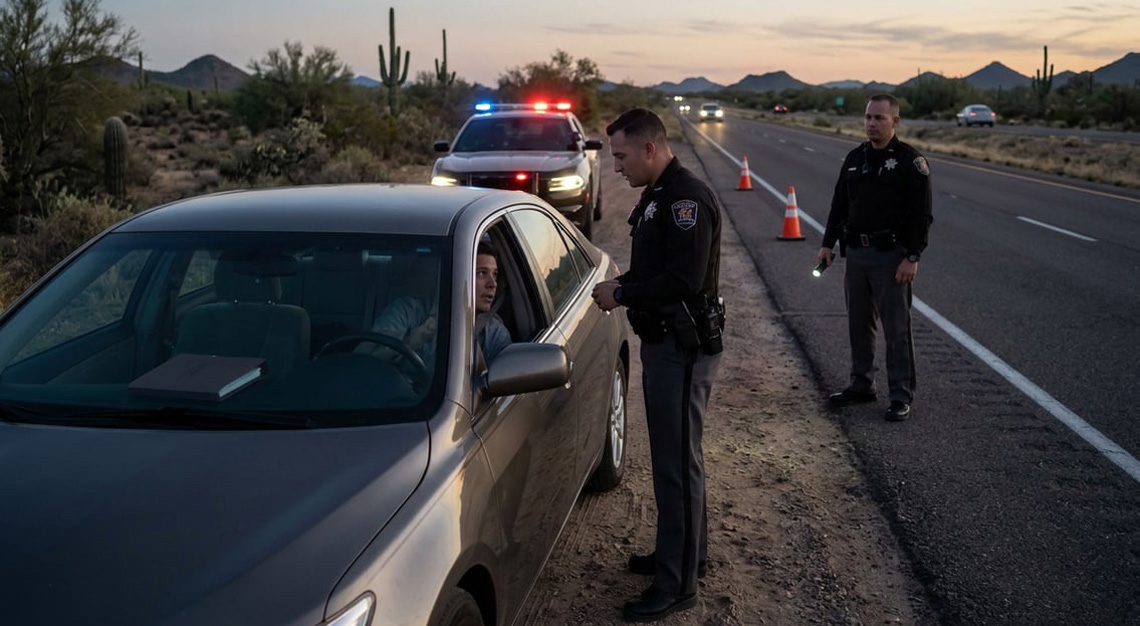
The traffic stop is the foundation of every DUI case, and an unlawful traffic stop can sink the whole prosecution. If the officer had no reasonable suspicion, the evidence gathered afterward can be ruled inadmissible.
To pull you over, an officer needs reasonable suspicion based on behavior they observed. Examples include speeding on I-10, weaving across lanes on Loop 101, rolling through a stop sign, or another civil traffic violation. A vague or unsupported reason can void the stop and everything that came after it.
Questioning Whether the Officer Had a Valid Reason to Stop You
Reasonable suspicion requires specific facts pointing to a violation. Getting stopped only because it was late at night on Mill Avenue in Tempe is very different from getting stopped for drifting over the lane lines. Statements like "you looked tired" or "your car seemed out of place" fall short of the legal standard.
Video is often the deciding piece. Bodycam footage, dashcam video, and dispatch records from Arizona police departments sometimes tell a different story than the officer's written report. When the video contradicts the report, your attorney has strong support for arguing the stop was illegal and the evidence should be suppressed.
A practical tip: staying calm and cooperative during the stop helps you, while resisting makes things worse. Cooperating does not give up your right to challenge the stop later in court.
Arizona Sobriety Checkpoints and Their Rules
Arizona agencies set up DUI task forces and checkpoints around busy holidays like New Year's Eve and the Fourth of July. Courts allow these checkpoints to stop drivers without individual suspicion, but only when police follow strict guidelines.
A lawful checkpoint requires:
- A predetermined, neutral pattern for choosing which cars to stop
- Public notice and clear signs
- Supervisor oversight
- Written planning documents that officers follow
When police skip these steps or cannot produce the planning paperwork, your attorney can move to suppress the evidence from that checkpoint. In some cases, that leads to dismissal.
Weak Spots in Field Sobriety and Chemical Testing

Breath, blood, and roadside tests are only as reliable as the people and equipment behind them, and mistakes give your defense room to attack. Prosecutors lean heavily on these tests to prove impairment or BAC, so any flaw can shake their case.
Roadside Test Mistakes and Medical Conditions
Field sobriety tests (FSTs) help officers decide whether they have probable cause to arrest. The National Highway Traffic Safety Administration approves three standard tests:
- Horizontal gaze nystagmus (HGN), which tracks eye movement
- Walk-and-turn
- One-leg stand
These tests must be given exactly as trained. Uneven ground on an SR-51 shoulder, poor lighting, wind, or rain all affect results. When an officer gives the wrong instructions or skips steps, the results become unreliable and open to challenge.
Your health also plays a role. Diabetes and neurological disorders can cause symptoms that look like intoxication. Back problems, knee injuries, inner ear issues, and age-related balance trouble make sober people fail balance tests. Because these tests are subjective, video that contradicts the officer's account is especially useful.
Tell your attorney about every medical condition and medication you take. Your lawyer can gather records or bring in an expert to explain your performance.
Breath Machines, Blood Draws, and Sample Handling
Arizona cases often rely on the Intoxilyzer 8000 breath machine or blood samples processed by the Arizona DPS crime lab or a county lab. Breath machines need regular calibration and accuracy checks. When those records are missing or show problems, the results can be suppressed. Calibration problems have led to dismissals elsewhere too, such as the Massachusetts Trial Court's handling of the Draeger 9510 Alcotest.
Other breath test problems include:
- A test given by an officer who was not certified to run the machine
- Medical conditions like GERD or diabetes that produce false-high readings
Blood test results have their own risks. Common issues include improper draw procedures, contamination, the wrong preservative, delays that affect BAC stability, and chain of custody errors that leave gaps in who handled the sample. Blood tests also matter in a drug-related DUI, where lab handling is just as open to scrutiny.
Timing can help you too. A rising BAC defense argues that your alcohol level was still climbing after you stopped driving, so the later test overstates your level at the wheel. If chemical evidence is suppressed, prosecutors may no longer be able to prove a BAC of 0.08 or higher.
Constitutional and Procedural Mistakes That Can End a DUI Case

Constitutional violations by police or prosecutors are another proven path to dismissing or reducing a DUI. Three amendments come up most often:
- Fourth Amendment: protects you from unreasonable searches and seizures
- Fifth Amendment: protects you from self-incrimination and covers Miranda rights
- Sixth Amendment: protects your right to a lawyer
Unlawful Searches of You or Your Vehicle
Officers in Arizona need a warrant or a recognized exception to search your car or take your property. Under the exclusionary rule, evidence gathered through an illegal search cannot be used against you.
Examples of a questionable search include opening a closed backpack in your trunk without consent after a routine stop. Searching your whole car after a minor equipment violation, with no sign of alcohol or drugs, is another. Evidence from an unlawful search, including open containers or observations made during the illegal encounter, can be suppressed.
Implied Consent, Miranda, and Other Procedure Problems
Arizona's implied consent law (A.R.S. § 28-1321) requires officers to tell you correctly what happens if you refuse a chemical test. Wrong or incomplete warnings can affect whether your test results are admissible.
Miranda warnings apply when police question you while you are in custody. Missing Miranda warnings will not dismiss the case by itself, but statements you made afterward can be excluded.
Other procedural issues that help your defense include:
- Lack of probable cause for the arrest or the request for a chemical test
- Charges filed late
- Failure to share evidence as required by the Arizona Rules of Criminal Procedure
- Missed deadlines that lead to court sanctions against the state
How Dismissals Happen in Arizona DUI Court

Most Arizona DUI dismissals happen before trial, when a judge rules on defense motions. After a DUI arrest, your case moves through these steps:
- Arrest and booking
- Initial appearance
- Arraignment
- Pretrial conferences
- Motion hearings
- Trial, if the case does not resolve earlier
The burden of proof stays on the state the whole time. You never have to prove you are innocent.
Pretrial Conferences, Hearings, and Defense Motions
Misdemeanor DUI cases in Arizona center on pretrial conferences and motion hearings, with formal preliminary hearings being less common. At these hearings, the judge decides motions that challenge the stop, the arrest, the tests, or the state's disclosure of evidence.
Your attorney may file a motion to suppress to throw out specific evidence, or a motion to dismiss to end the case. If the judge excludes something central, such as breath results or an officer's observations after an illegal stop, the prosecutor may announce a dismissal right there in court. Careful, well-timed motions are the main way Arizona drivers get a DUI dismissed.
Other Results When Dismissal Is Unlikely

Some Arizona DUI cases cannot be dismissed, but a reduced charge or lighter penalties is still a realistic goal. Your criminal record and driving history weigh heavily in how prosecutors negotiate.
Common outcomes short of a DUI conviction include:
- A plea to a non-DUI charge such as reckless driving
- A reduction from extreme DUI to standard DUI
- An agreement that limits jail time or fines
Some facts make dismissal much harder. These include a BAC of 0.20 or above, which falls under super extreme DUI, a crash that caused injuries, a child in the car, or a second or third DUI.
Diversion programs are another option for some first-time offenders. You complete set requirements, and the charge is dismissed. Availability depends on the court and your situation.
A private attorney gives your case close attention and digs into the details of your arrest. That investigation can uncover mistakes leading to dismissal, or at least a much better result.
Final Thoughts on Getting an Arizona DUI Dismissed
An Arizona DUI can be dismissed when the state's case rests on an illegal stop, unreliable tests, or a violation of your rights. Most dismissals come from motions to suppress filed before trial. When dismissal is not possible, negotiation can still reduce the charge or the penalties. Request your MVD hearing within 15 days and get your case reviewed by a lawyer right away.
Frequently Asked Questions About Arizona DUI Dismissals
Is a first-time DUI in Arizona easier to get dismissed than a repeat offense?
A first offense does not make dismissal automatic. Dismissal depends on legal problems with the stop, testing, or evidence, not on a clean record. A spotless history does help during negotiations and can open the door to reduced charges or a diversion program. Younger drivers face separate rules, so an underage DUI follows its own standards.
Will my DUI be dismissed if my BAC was below 0.08?
A low blood alcohol concentration does not guarantee dismissal. Arizona's "impairment to the slightest degree" law allows a charge even under 0.08. A borderline reading can still support a reasonable doubt argument or a motion challenging whether the evidence is strong enough.
What if I was not driving when the police found me?
Arizona uses an "actual physical control" rule. Sitting in the driver's seat with the keys in the ignition can lead to a charge. Your defense can challenge whether the state can prove control, looking at where the car was parked, whether the engine was running, where the keys were, and what you intended to do.
Do Miranda violations automatically get my DUI dismissed?
No. A Miranda violation can suppress statements made after the violation, but the case continues. If those statements are key to proving impairment, losing them can support a successful motion to dismiss.
How soon should I call a DUI attorney after my arrest?
Call a DUI attorney as soon as possible after your arrest. You have only 15 days to request an MVD hearing to protect your license. Early action lets your lawyer preserve video and records before they disappear and spot grounds for dismissal while the facts are fresh.
How Mesa DUI Lawyer Builds Your Case for Dismissal
Mesa DUI Lawyer Attorneys at Law defends DUI clients across Arizona's city, justice, and superior courts, handling both misdemeanors and felonies. The firm's DUI defense team looks for dismissal grounds by reviewing:
- Police reports
- Bodycam and dashcam footage
- Breath machine calibration logs
- Crime lab records
- Witness accounts
Each court runs differently. The team shapes its strategy around the specific court, whether that is Phoenix Municipal Court, Scottsdale City Court, or Maricopa County Superior Court, along with the assigned prosecutor and judge. You can review past DUI case results to see the kinds of outcomes the firm pursues, from dismissals to reduced charges.
If you were arrested for DUI in Arizona, contact a Phoenix DUI attorney at Mesa DUI Lawyer promptly to preserve evidence and protect your license and record. Call (480) 660-2676 to schedule a confidential consultation and get advice specific to your case.


